
Quick Access
Applications
Quick Links
Goal 6. Clean Water and Sanitation
How the University runs itself: policies, offices, management systems and support services.
Özyeğin University has been calculating and reporting its water footprint regularly since 2018. The Institutional Water Footprint Inventory Report 2025, prepared by the Sustainability & QHSE Department in accordance with the ISO 14046 Water Footprint Standard, covers the Çekmeköy Campus and the student residences for the 2025 reporting period. According to the report, the University's blue water footprint was 256,819 m³, its grey water footprint 412,579 m³ and its green water footprint 764 m³ in 2025, bringing the total water footprint to 670,162 m³ (67.02 m³ per person). When the virtual water footprint of food and materials consumed on campus is included, the total per-person footprint is 230 m³, well below Türkiye's average of 1,977 m³ per person.
The SDG Report 2025 also reports the water withdrawn through the campus meter: 64,028 m³ in 2025, or 9.33 m³ per person. The two figures measure different things. The meter reading is the water withdrawn at the campus meter, while the water footprint inventory follows ISO 14046 and covers the Çekmeköy Campus and the student residences.
The University has set a target of reducing total water consumption by 8% over a four-year period, and progress toward this target is regularly monitored by senior management. Water consumption metrics have been incorporated into the institution's strategic goals, and data monitoring and performance evaluations are conducted periodically to track progress toward water conservation and efficiency targets. This makes improvements in water management measurable and embeds continuous improvement into the institutional culture.
Özyeğin University implements the ISO 46001 Water Efficiency Management System standard to systematically manage water efficiency. ISO 46001 helps organisations measure, monitor, analyse and continuously improve water consumption, reduce water waste and minimise environmental impacts. The continuity of the process is ensured through internal and external audits, and the University's Water Efficiency Management System certification was renewed following the audit conducted in 2026.
Metering and leak detection: real-time metering and automation now cover 95% of building entries, and a Water Efficiency Management Team tracks the action plan monthly and reviews targets quarterly with senior management. Analysing İSKİ invoices by supply line revealed a leak of at least 45,600 m³ on the residence supply main, which was repaired in August 2025; new leaks are located with acoustic listening devices and logged on technical inspection forms.
Özyeğin University has a process in place to make sure that all wastewater produced on campus is treated before it returns to the environment. The process combines pre-treatment on campus, treatment at an advanced municipal plant, and regular monitoring under the University's certified environmental management system.
Wastewater from campus buildings is carried through the University's main pipelines to the collection points (sewer lines) of İSKİ, the Istanbul Water and Sewerage Administration. It is then treated at İSKİ's Paşaköy Advanced Biological Wastewater Treatment Plant. The plant has a treatment capacity of 100,000 m³ a day, serves a population of 500,000 and uses advanced systems for sludge drying, UV disinfection and biofiltration. Regular audits are carried out to verify that the University's wastewater is treated.
The University reduces the pollution load of its wastewater before it leaves the campus:
Wastewater quality measurements are carried out monthly by İSKİ and published on its website. On campus, wastewater management is part of the University's ISO 14001:2015 Environmental Management System, in place since 2012 and certified since 2014, and of its zero waste practices. The system is checked every year through internal and external audits, and the certification was renewed after the audit in 2026. The Health, Safety and Environment Department oversees these processes, and the University's Environmental Management Plan sets out the related procedures and responsibilities.
Özyeğin University has processes to stop polluted water from entering the water system, both in day-to-day operations and when accidents or incidents occur. These processes are part of its ISO 14001:2015 Environmental Management System and are set out in the University's Environmental Management Plan.
The University carries out all its operations within the scope of the ISO 14001:2015 Environmental Management System and zero waste standards. It has been certified to ISO 14001 since 2014. The system is checked every year through internal and external audits, and the certification was most recently renewed after the audit in 2026. The Environmental Management Plan aims to eliminate hazards at the source and sets out preventive and protective measures, responsibilities and controls for the whole campus.
All staff and students are expected to follow these plans, report incidents and take part in training. Environmental training follows an annual training plan, including for subcontractor staff, and training records are kept. Compliance is checked periodically, and any non-compliance is recorded and followed up until it is closed.
Özyeğin University provides free drinking water for students, staff and visitors across the campus. Filtered, mains-fed drinking water points are available in every academic building, the student centre, the sports centre and the dormitories, and anyone on campus can refill a bottle at them free of charge. In orientation week, every new student is given a steel water bottle as a sign of the University's commitment to this policy.
The campus has 91 mains-fed drinking water units with built-in filtration: 58 water dispensers in corridors, common areas and shared kitchens, and 33 under-sink purifiers in shared kitchens. The table shows the campus drinking water inventory as of October 2026.
| Building | Water dispensers | Kitchen purifiers |
|---|---|---|
| Academic Building 1 (AB1) | 9 | 5 |
| Academic Building 2 (AB2) | 9 | 5 |
| Academic Building 3 (AB3) | 3 | 2 |
| Academic Building 4 (AB4) | 7 | 5 |
| School of Languages (ScOLa) | 3 | 1 |
| Student Centre | 4 | 5 |
| Sports Centre | 4 | 1 |
| Dormitories | 17 | 7 |
| Other campus buildings | 2 | 2 |
| Total | 58 | 33 |
In addition to these points, 45 bottled-water dispensers serve security posts, offices and service areas, and 17 more are kept for events on campus.
Every new student learns where to refill a bottle. The Environmental Sustainability module of the compulsory first-year courses SEC 101 and TRL 101/103 explains that students and staff can fill their own bottles at the filtered dispensers and kitchen purifiers, and marks the dispensers in shared areas on a campus map.
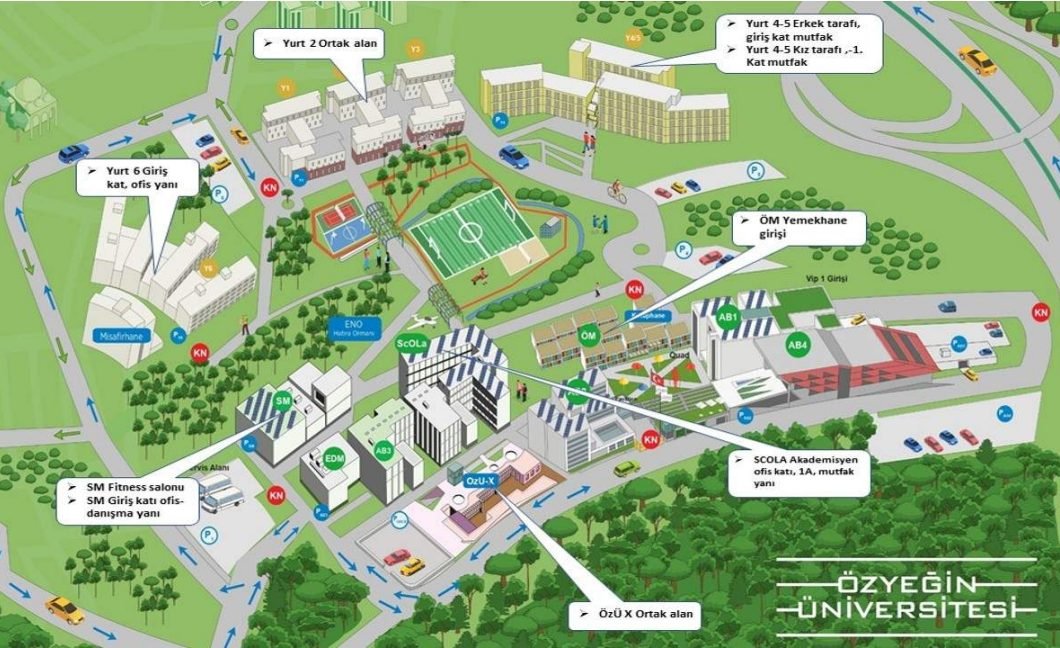
Water supplied by İSKİ is collected in the campus raw water reservoir, filtered and treated again by the campus purification system, and stored in potable and soft water reservoirs before it is distributed across the campus. External authorised providers check the potable water periodically by taking samples for analysis. Authorised service providers maintain the hydrofor and pump groups regularly. The Operation Management Team keeps the water reservoirs clean and hygienic, and the Health, Safety and Environment Department checks this work.
Özyeğin University's academic buildings have LEED Gold certification, and one academic building was built as a European Union project (NEED4b) that exceeds LEED standards. These buildings are designed to minimise water use.
Water-saving fittings are standard across campus buildings:
Fixture renewal in the Year of Water (2025–26): 1,348 water fixtures were renewed across the campus, including 640 sensor taps, 533 angle valves and 175 urinals, and 1,000 water-saving cartridges were purchased. Direct water-related investment also covered rainwater-harvesting infrastructure.
Özyeğin University reduces irrigation demand through its choice of plants and irrigation methods:
A full plant inventory (2025–26): all 89,795 plants in the campus landscape were inventoried and 73,403 of them (81.7%) were classed as drought-tolerant. Drought-tolerant planting now covers 17,600 m², and irrigation has been switched off entirely on 11,845 m², 21% of the 55,214 m² landscaped area. Irrigation leaks were repaired and schedules optimised by plant need and season. The ÖzÜ Bostan community garden moved to drip irrigation with a rain-sensor shut-off in December 2025. The Ministry of Agriculture and Forestry's Provincial Directorate has cited the University's drought-tolerant landscaping as a good-practice example for the sector.
The Özyeğin University Environmental, Energy and Water Efficiency Policy embraces the "reduce, replace or reuse" approach for the efficient use of water. It commits the University to monitoring, measuring and analysing water consumption, setting water efficiency indicators and performance goals, evaluating water efficiency opportunities when designing new buildings, equipment, systems or processes, and assessing suppliers of water-intensive services, products and equipment on their water efficiency performance. The full text of the policy is published on the Goal 12 Campus Operations page. During the 2025 reporting year version 8 of the policy (POLI_EMP_01) was in force. It was revised on 5 September 2025 to align with the ISO 46001 water efficiency standard. The current version is dated 7 September 2026.
The Campus Energy and Water Resources User Manual and the Environmental Management Plan set out the University's water management principles and measures in detail.
In practice, water is reused across the campus in two ways:
Recycled water is calculated and included in the University's water footprint calculations, prepared under the ISO 14046 standard. The campus water infrastructure is inspected regularly and monitored continuously so that leaks are detected early and water loss rates are kept to a minimum.
Rainwater use is measured as well. The Institutional Water Footprint Inventory Report 2025, prepared under ISO 14046, records a green water footprint of 764 m³, the rainwater component of the University's water use. Rainwater is collected in three tanks holding 260,000 litres in total and used for garden irrigation, landscaping and cleaning instead of treated drinking water.
Özyeğin University manages the water it takes in so that its use of the resource stays efficient and sustainable.
In line with the national Water Efficiency Mobilization and the Water Efficiency Regulation published in December 2024, Özyeğin University designated 2025 as the "Year of Water". Highlights included:
A Water Efficiency Training Module has been prepared and made available to all stakeholders. Face-to-face training on environmental legislation, the Water Efficiency Regulation, the Zero Waste Regulation and the ISO 14001, ISO 46001 and ISO 50001 standards was held for cleaning, kitchen, technical and landscaping staff and for business and tenant employees on campus.