
Quick Access
Applications
Quick Links
Goal 5. Gender Equality
Gender equality is a question of governance as well as culture. Özyeğin University has implemented a Gender Equality Plan since 2017, supports working parents beyond what the law requires, and produces national evidence on violence, care work and women's employment with international partners.
Source: Özyeğin University SDG Report 2025, SDG 5 chapter, page 31 (PDF).
Source: Özyeğin University SDG Report 2025, SDG 5 chapter, page 32 (PDF).
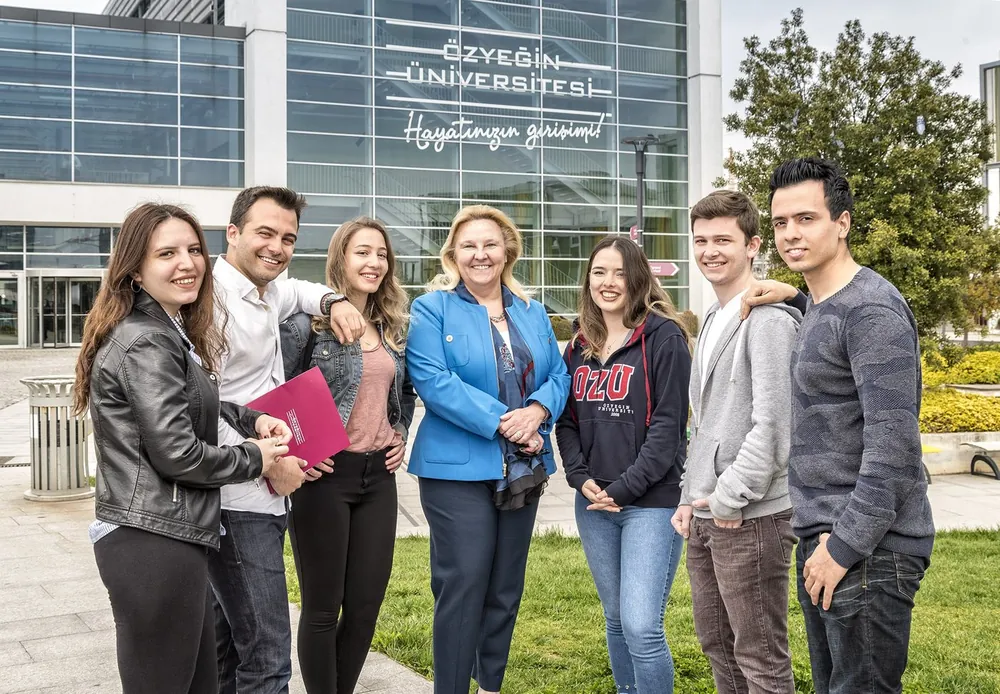
Gender equality is part of what students learn and do. The elective Safe Sport and Gender brings the subject into the curriculum, and Gender Equality Plan v2 names curriculum and students among its seven key areas. The Gender Ideathon asks participants to develop solutions to social problems; its 2025 edition focused on care labour and mental load.
Role models and peer networks carry much of the work. On 8 March, 72 students met 22 women leaders from business, and the Her Story Our Glory panel brought women executives to talk about their careers. The Equality Ambassadors network gives students a structured space to lead discussion, the Women's Studies Club runs consciousness-raising sessions and film talks, and students also organise women's self-defence training and the Non-Violent Society Summit on rights-based awareness. Breaking Gender Stereotypes, run by the Social Change Volunteers with a lawyer from the We Will Stop Femicide Platform, produced an equality board now displayed on campus. Workshops with TEVİTÖL high school students examined gender stereotypes in career choice.
Gender Ideathon 2025, run with Fiba Group on care work and mental load, with 36 participants.
Source: Özyeğin University SDG Report 2025, SDG 5 chapter, page 33 (PDF).
Özyeğin has treated gender equality as a governance question since 2016, when the Horizon 2020 PLOTINA project began with an internal gender audit. The first five-year Gender Equality Plan was published in 2017. Its second cycle, GEP v2 for 2024–2028, was approved by the Senate in May 2024 after an evaluation of the first plan, strengthens data-driven monitoring with annual reporting, and widens the key areas from five to seven: governing bodies and decision-makers, career development, recruitment and work-life balance, research and researchers, curriculum, students, and knowledge transfer.
The Gender Equality Office, established in 2021 with two gender experts and an advisory board, implements the plan, collects gender-disaggregated data with the Planning and Analysis Office every year and publishes it in the Gender Equality Reports. The Equity, Diversity, Inclusion and Belonging Policy prohibits discrimination on grounds including gender and gender identity and names hiring practice among its six action areas, and the Unit for the Prevention of Discrimination and Violence supports anyone affected. The Working Parent Rights Guide, part of the ÖzÜ'nde Biz Varız series, sets out rights the University provides beyond statutory requirements. Employees receive a nursery allowance, breastfeeding leave is extended by institutional practice from one year to two, and mothers may take one day off a week until the child is 24 months old. Work to expand breastfeeding rooms and to agree nursery discounts is under way.
"University Empowering the Future of Women" award, received by the Gender Equality Office in 2025.
Source: Özyeğin University SDG Report 2025, SDG 5 chapter, page 34 (PDF).

The University's gender work reaches deep into the private sector. The Goldman Sachs 10,000 Women programme was delivered in Türkiye for the first time with the University, and a gender equality seminar was later given to members of the 10,000 Women Entrepreneurs Association at their request.
Public conversation and field work are the other channels. The Equimundo workshop with AÇEV explored young men's role in equality. The University supports women's cooperatives in Iğdır and trains trainers on business models for cooperatives, and through a collaboration with Women in Renewable Energy works to increase women's participation in the energy sector.
A gender equality event hosted on campus, 13 February 2025.
Empowering migrant women entrepreneurs in Türkiye, a 2025 Societal Impact Seed Grant project with International Women of Istanbul, combining skills workshops with field research.
Distinguished Leaders at OzU, whose equality and inclusion sessions in 2025 brought leaders with global impact to the University community.
What began as Fiba Group's awareness campaign, with the "Equal Care and Equal Mental Load Awareness Guide" co-developed by the University, became a national study with more than 2,600 white-collar employees, reported in 2025. It found that 31 per cent of women had resigned from a job at some point because of care responsibilities and mental load, evidence that companies now use to change their HR policies.
Source: Özyeğin University SDG Report 2025, SDG 5 chapter, page 35 (PDF).
European and National Projects
Özyeğin produces large-scale evidence on gender and work. With ILO Türkiye, researchers surveyed 3,007 people in Istanbul on violence and harassment at work, the first study of its scale in the country, published as Workplace violence and harassment: perceptions and experiences. A two-phase national study with 2,628 white-collar employees measured the mental load of care work, and its report was published with Fiba Group in 2025. Also in 2025, a study with the Eastern Black Sea Development Agency (DOKA) examined 38 women's cooperatives in six provinces and developed tailored development plans. The Work, Inclusion and Social Equity Research Centre (WISE) turns this work into data and policy outputs.
Other projects study cultural life scripts and system justification among women, and food, home cooking and social cohesion among Syrian women in Istanbul, Gaziantep and Hatay. PLOTINA, the Horizon 2020 project with ten European institutions, is where the University's Gender Equality Plan began. Özyeğin was the first institution from Türkiye to join RINGS, the international network of gender research centres, and the ÖzÜ–WiRE collaboration studies women's participation in the renewable energy sector. Dr Başak Ozan Özparlak was named among 100 Inspiring Women in 6G.
Scopus-indexed outputs mapped to this goal in SciVal.
Since the reporting period · 2026
Women's Leadership Programme. Designed for women undergraduates, especially those facing intersecting disadvantages, with targets of 25 mentees, 15 leadership workshops for 100 students, Experience Days with three companies for 75 students, and international mobility and internship support for 10 students. Mentoring starts in December 2026.
The Care Equality Corporate Network, Türkiye's first, convened by Özyeğin with TÜSİAD and with Fiba Group as principal supporter, turning invisible care work into a measurable corporate agenda.
IFC Equality in Education and Employability (E3), an eighteen-month international peer-learning platform on equality in education and employment, run with the International Finance Corporation.
The İşin İçinde Kadın podcast, produced with AÇEV, in which eleven academics discuss women in working life.