
Quick Access
Applications
Quick Links
Goal 13. Climate Action
Climate change is the defining challenge of our time. Özyeğin University measures its emissions across all three scopes, sources its electricity from renewables, compensates its remaining direct emissions, and brings climate research and climate education to students, business and public bodies.
Source: Özyeğin University SDG Report 2025, SDG 13 chapter, page 72 (PDF).
Source: Özyeğin University SDG Report 2025, SDG 13 chapter, page 73 (PDF).
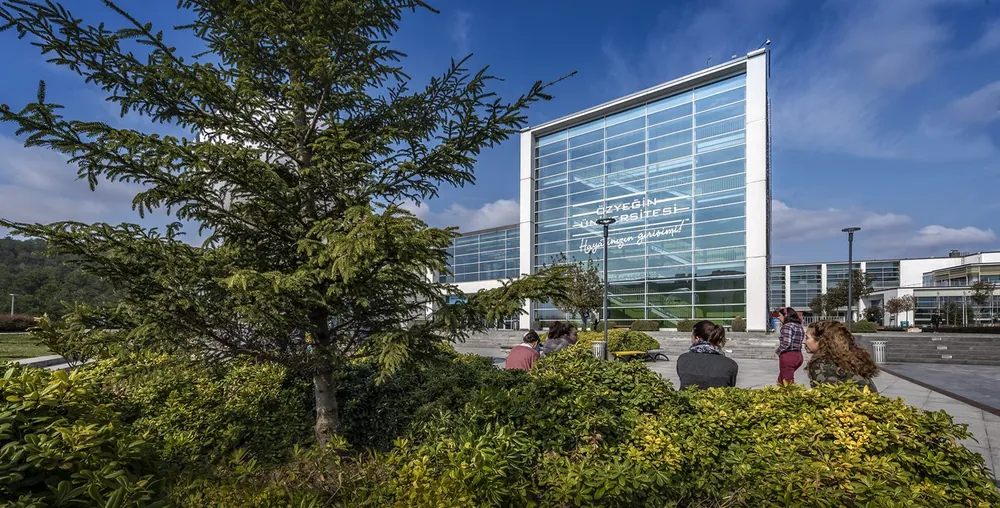
Climate is taught across programmes and through events that practise what they teach. In March 2025 the University held three carbon-neutral activities for the first time: the Being an Engineer course on 21 March, the Journey of Water seminar on 20 March and the We Melt What We Consume event on 19 March. For each, the carbon footprint was calculated and offset with a margin through Gold Standard-certified credits from a renewable energy project.
Students work on climate solutions through the Sustainability Ideathon, Future Greens and Sustainable Conversations with alumni. A biodiversity nature excursion on 1–5 October 2025 taught ecosystem protection in the field, and the sustainability orientation reaches every incoming student.
SustainHUB Academy, the green transformation programme, in its second cohort.
Future Greens, on climate-focused solution development and sustainable business models.
Environment, ecosystem and climate themed courses across the curriculum.
Source: Özyeğin University SDG Report 2025, SDG 13 chapter, page 74 (PDF).
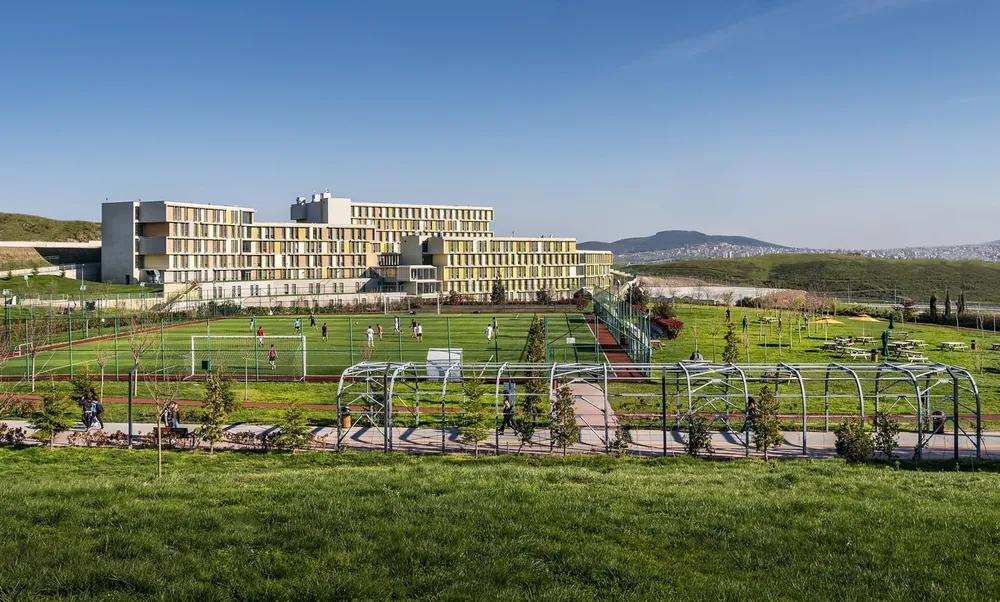
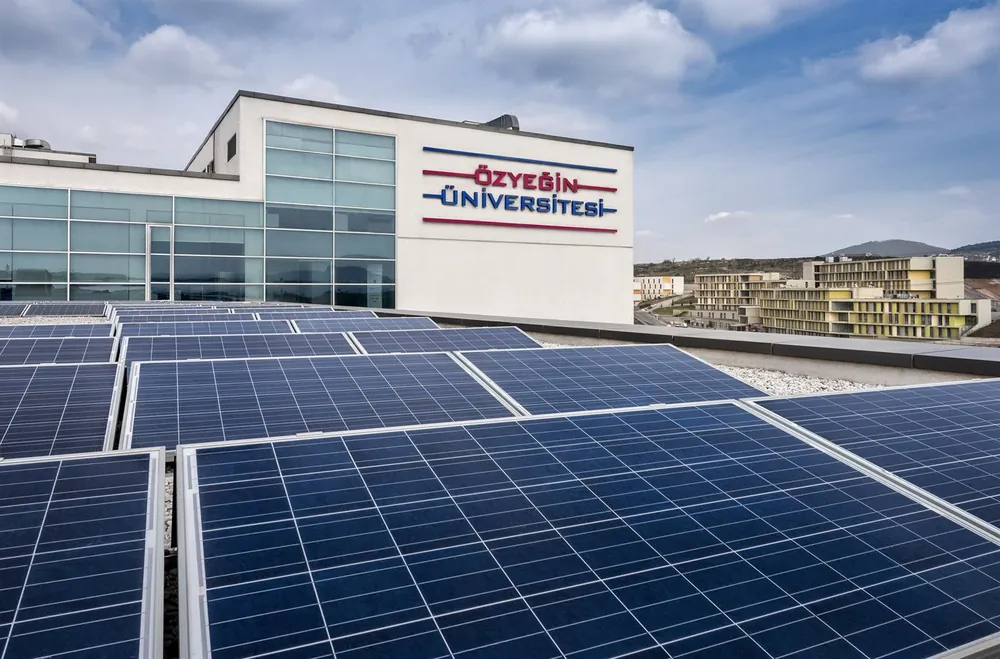
Özyeğin measures its emissions, reduces what it can and compensates the rest. It was the first university in Türkiye to publish a carbon footprint report, in 2020, and now calculates its footprint under ISO 14064 across Scopes 1, 2 and 3. Since 2024 all purchased electricity has come from renewable sources documented by I-REC certificates, and solar energy is generated on campus.
For 2024 and 2025, Scope 1 and 2 emissions were offset with Gold Standard verified credits, 9,331.96 tonnes of CO2e in 2025. The University's sustainability strategy is organised around five impact pillars, including Environment and Climate Action, and is aligned with its 2024–2029 Strategic Plan. It is coordinated through the Sustainability Platform, the QHSE Department and the Social Impact Committee.
Scope 1 and Scope 2 emissions for 2024 and 2025 were compensated with Gold Standard verified carbon credits: 9,331.96 tonnes CO2e in 2025.
ISO 14064 corporate carbon footprint, calculated across Scopes 1, 2 and 3. Scope 3 calculation is listed as a concrete output in the QHSE impact report.
100 per cent renewable electricity, I-REC certified, for both 2024 and 2025.
Karbonmetre and Sumetre, the environmental metering tools.
The Sustainability Report 2025 commits the University to carbon neutrality by 2040 through phased reductions across Scope 1, 2 and 3. Its 2029 milestones are a 17.49 per cent cut in greenhouse gas emissions, to 7,425.6 tCO2 a year, and a 10.57 per cent cut in energy use per person. Offsetting is treated as a transitional measure; priority goes to efficiency, renewable energy and operational change. A formal Climate Action Plan and carbon neutrality roadmap are being prepared.
Source: Özyeğin University SDG Report 2025, SDG 13 chapter, page 75 (PDF).
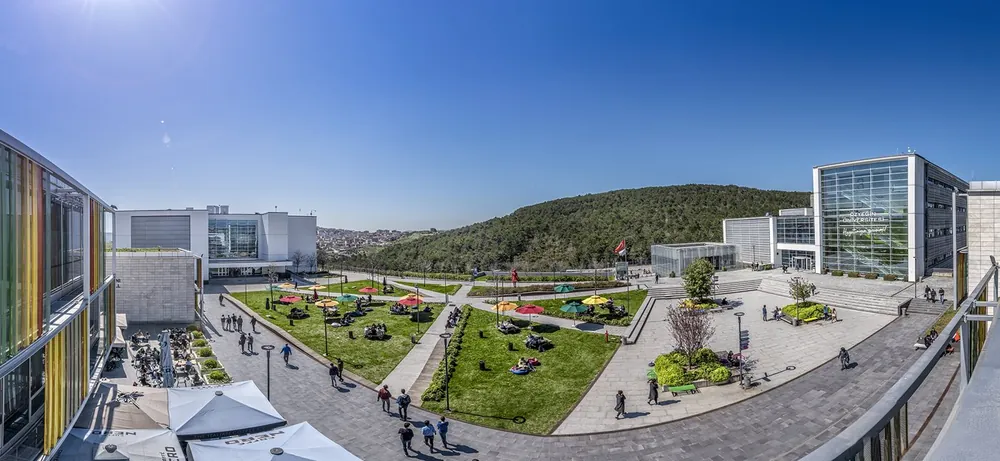
Özyeğin works on climate within international networks. It sits on the European University Association's sustainability task force and has been a member of the International Sustainable Campus Network since 2015. It signed the UN Global Compact in 2018 and reports in Enhanced CoP format aligned with GRI, CDP and ISAR.
At home, the University took part in the Fiba Sustainability Meeting on 17 December 2025, where 45 people from twelve affiliated institutions and three external stakeholders exchanged practice. It supports environmental camps run by the Simurg youth association, and ATTUNE, an Erasmus+ partnership started in 2023, mobilises universities on climate change.
Özyeğin University is a member of the group of experts working on the post-2030 sustainability agenda of European universities.
The International Sustainable Campus Network, member since 2015, through which campus practice is benchmarked internationally and published as case material.
Signatory, with the Communication on Progress published in Enhanced CoP format aligned with GRI, CDP and ISAR, and the commitment declared publicly by the Rector.
The Fiba Sustainability Meeting, 17 December 2025, where 45 people from 12 affiliated institutions and three external stakeholders exchanged good practice.
Source: Özyeğin University SDG Report 2025, SDG 13 chapter, page 76 (PDF).
European and National Projects
Climate research at Özyeğin spans energy, construction, agriculture and disaster risk. EÇEM and the Integrated Energy Initiative lead energy work, ReBuild-3D develops low-carbon construction materials, and LEGOFIT and NEED4B have tested storage and building efficiency on campus. A Seed Fund project studies early warning and parametric insurance to make agricultural supply chains resilient to climate risk.
The campus is itself a laboratory. From 8 May 2025, sensors on campus trees measured the urban heat island for six months, and a thermal comfort survey covered five open spaces on 20 June 2025. Disaster research, from emergency shelter models to earthquake risk perception, links climate adaptation with urban resilience.
EÇEM — the Centre for Energy, Environment and Economy, and iEi, the Integrated Energy Initiative.
AGRICOLAB, climate-resilient agriculture in Yenişehir under the EU–Türkiye Climate Change Fund.
Campus Tree Sensor Research, run as a living laboratory.
The Post-Earthquake Emergency Shelter Model, on climate and disaster resilience in the built environment.
PHOENIX (Belmont Forum, 2023–2026, funded in Türkiye by TÜBİTAK) studies climate-related mobility and social tipping points in nine countries, with Asst. Prof. Susan Beth Rottmann as one of its coordinators.
Scopus-indexed outputs mapped to this goal in SciVal.